JOURNAL: An online notebook updated by the artist


The Bend

August 17th, 2008

The Bend, 1984, watercolor, graphite, and pen and ink on Fabriano paper, 3 5/8 x 14 7/8″.

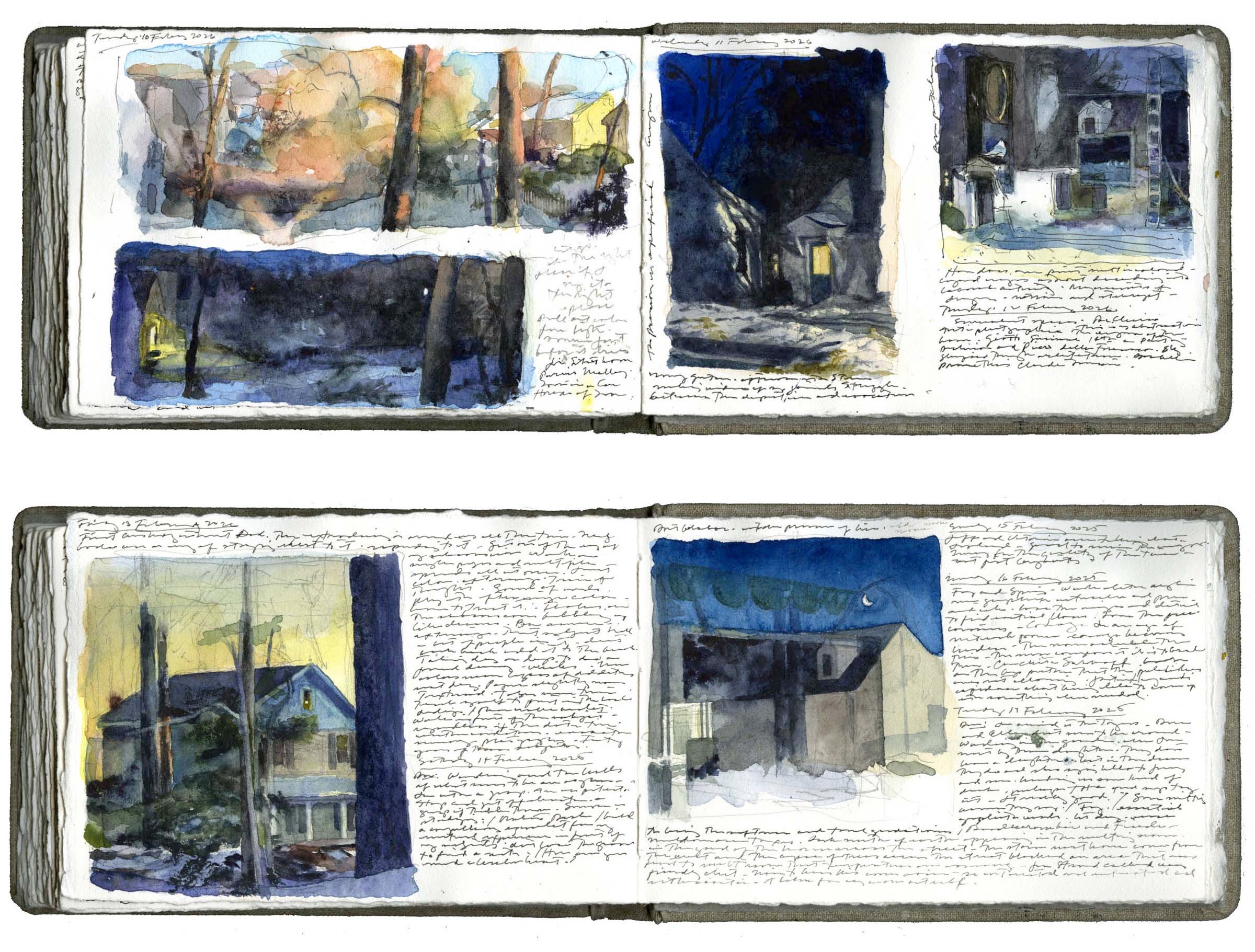
My journals are filled with watercolor studies that explore options for images I am creating outside of my books. For example, during the summer and fall of 1984, one of the independent works I developed was The Bend (above), an image of a road set in a long format composition. Books 30 and 31 (below) contain studies that establish compositional details as well as offer various solutions for the borders of that work. While a long rectangle with a gently arched top was selected for the final composition, the books show that other configurations were proposed; including a broad box shape with no arch. I was looking for a way to create visual interest by maximizing tension between the long, wavelike shape of the road and the arched top of the composition’s border. One of the wonderful things about keeping a journal is being able to go back and trace the development of an idea.

Book 30, Summer 1984, sheet: 4 1/4 x 6″, watercolor graphite, and pen and ink on wove paper in bound red linen volume

Book 31, Fall 1984, sheet: 4 1/4 x 6″, watercolor graphite, and pen and ink on wove paper in bound red linen volume

The Bend and the two journals presented here are among the 65 works on view in the exhibition From the Inside Looking Out: The Journals, Drawings and Prints of Charles Ritchie, on view at The Gregg Museum of Art & Design, North Carolina State University, Raleigh from 21 August to 8 October 2008. The show opens Thursday evening 21 August with a 5 pm lecture by the artist, Staring Back.


Risk: Turning Pages, Part 2

August 13th, 2008

Charles Ritchie, Interior with Stack of Journals, work in progress, second state, watercolor and graphite on Fabriano paper, 4 x 6″.

Risk: Turning Pages, Part 2

When is a work of art complete? When is it overworked? When is the artist signing off prematurely; too easily satisfied? These are difficult questions that permeate the core of painting.

My online journal entry on 1 June examined the abandoned watercolor, Interior with Stack of Journals and my plans to reinvestigate the image on another sheet. Through the summer I have continued work on the second attempt (see above), taking advantage of the period when the early evening light enters the west window of my studio. As the season comes to an end, and the specific lighting on my subject drifts away, I find myself pleased with the work. It has reached a plateau, as many drawings do; very close to way I had envisioned it, with some surprising details evolving; the mirror on the desk reflecting a bit of interior, for instance. However, the big improvement is that the brightness of the landscape has remained; far preferable to the overworked landscape in the previous version.

A plateau can be dangerous, though. One might easily convince oneself the work is done. At any point along the creation of an image there are times of balance and imbalance. I consider the present manifestation of Interior with Stack of Journals (above) a balanced composition, but not yet finished. My major dissatisfaction is that I want the interior to be darker in very specific places; more like my most recent preparatory journal sketch (Book 130, 11 May 2008). To accomplish this I will apply wash; not too dark not too light. If done just right it will increase contrast with the light from the window while integrating details and further unifying the composition.

Time is short, though. I prefer to work in front of my subject so I must make my move in the next few weeks or leave the project until next May when the same lighting situation returns. I don’t like to work purely from memory in a case like this one. The visual reinforcement of the subject cultivates courage to take the necessary risk. I have found that the best response to the present situation is to put the work away for a while, get involved in many other drawing and printmaking projects. In the next month, I will forget the problem and then surprise myself when I finally make my move to finish.

One might recall the well-known sequence of photographs in which Henri Matisse documented his Large Reclining Nude (final state seen here) through twenty-two states during a six month period in 1935. I see numerous places Matisse might have stopped his work that could be seen as more successful than the one he chose as a culmination. Even the best artists are challenged by the “when is it finished” question. It’s also important to note that certain media facilitate continual change; Matisse used oil paint for his Large Reclining Nude, a very forgiving medium. Watercolor is different. One cannot scrape out with ease or paint over without damaging the luminosity. Watercolor ups the ante. To continue working my drawing carries the risk of overworking it. I could be faced with starting over again.

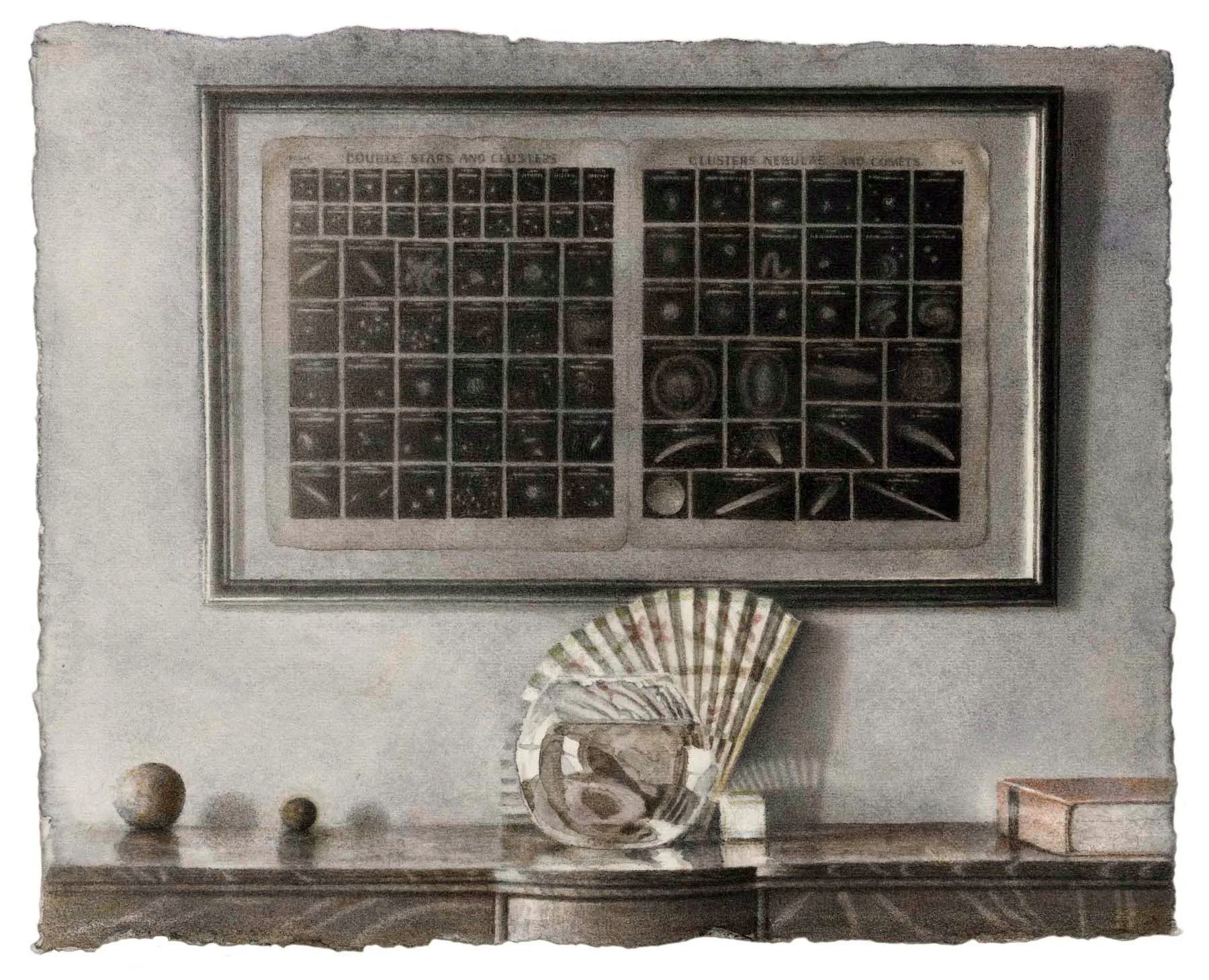
In 1994, I took a risk with my drawing Daffodils with Astronomical Chart. Tearing off the upper section of the sheet, I painted a final layer of darkness, completing the work with a move that I think improved it significantly. (To be continued)

Charles Ritchie, Daffodils with Astronomical Chart, (left) early state c. April 1993, (right) 1995, drawing completed, watercolor, graphite and pen and ink on Fabriano paper, 4 11/16 x 5 1/2″, note: left image is taken from a slide; color and tone are inaccurate. The finished drawing is in the collection of the Butler Institute of American Art, Youngstown, Ohio.


My Bookhouse

August 4th, 2008

My Bookhouse. Two volumes from a set of six, The Latch Key, volume four (left) with cover by Joseph Cheneweth and The Treasure Chest, volume six (right) with cover by N.C Wyeth.

My Bookhouse

I treasure early memories of visiting my grandparents’ house in North Carolina where before bedtime we could read from My Bookhouse. These six gorgeous volumes (two are pictured above), published in the 1920’s, are filled with all the children’s stories you can think of, plus some, and embellished with works by Howard Pyle, N. C. Wyeth, and many others who forged the golden age of American illustration. My Bookhouse probably represents my first recollection of art as art.

How I love these images. They always surprise. You can never tell where they will be when you turn the page. They are imaginatively configured; often shaped irregularly, stretching across the top, or bottom, or up the side margins. Their use of color is savvy too; just a few hues blossom into alchemy greater than the parts with maximum expressive effect. And the dense, sparkly, letterpress type was an invigorator. It commanded your eyes to move through pages like waves. Even the lesser known artists could be fabulous. As an example, look at the Sugar Plum Tree by Eugene Field, illustrated by Donn P. Crane (see below). Crane is not a well known figure, but these images embody all that I mention above and have stuck with me for many, many years. With my deep interest in dreams, it is surely no accident my favorite poem beckoned to the garden of shut-eye town and a land of visions.

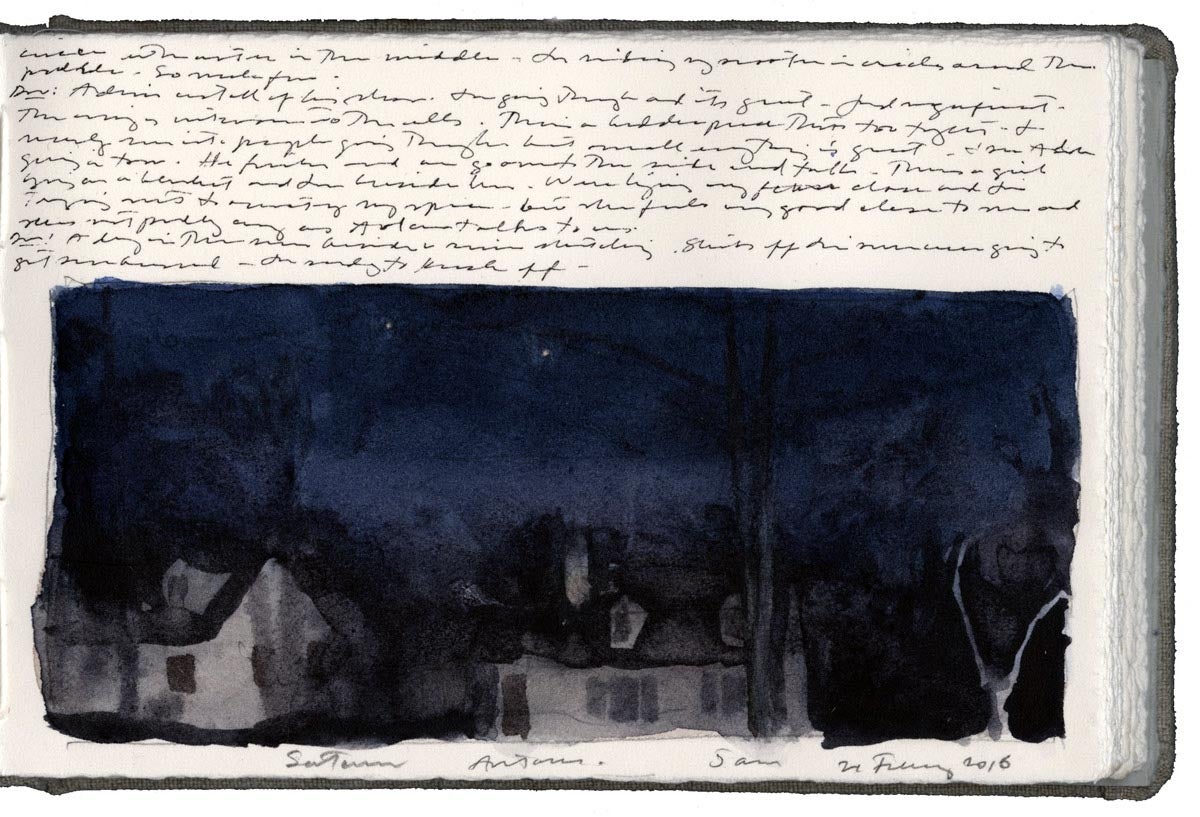
When I look at the pages of my journals (see below), I can’t help but think that in my own way I have been trying to create a Bookhouse of my own. I covet the element of surprise in My Bookhouse, the use of limited color to maximum effect, and dense regiments of words cultivated as expressive elements. And certainly the words “book” and “house” resonate off of my artistic trajectory. I believe that some of our earliest worldly encounters are the most powerful and lasting. My Bookhouse was fundamental for me.

My Bookhouse, In the Nursery, volume one, pp. 160-161, The Sugar Plum Tree, by Eugene Field, illustrated by Donn P. Crane. Edited by Olive Beaupre Miller, Published by The Bookhouse for Children, Chicago and Toronto, 1925 edition.

Charles Ritchie, Book 122, Jourrnal entries for 2-3 August 2002 including several studies for works in the Self-Portrait with Night series, watercolor, graphite, and pen and ink on Arches paper, 4 x 12″.

Footnote: Donn P. Crane went on to illustrate many story and textbooks through the early and mid-20th century, even contributing to the Dick and Jane series that taught a generation of Americans to read in the 1950s.


Painting Again

July 30th, 2008

Charles Ritchie, two uncatalogued paintings, (left) Paper Whites, 1990-1992, 5 x 3 7/8″, (right) Roses, 1992, 5 3/8 x 3 7/8″, oil on gessoed mat board.

Painting Again

Previous experience can inform the new unexpectedly. While working at Center Street Studio print workshop, I was exploring a new medium, whiteground (see entry for 23 July 2008). At first I felt very comfortable using the material; it reminded me of working up paint with a brush and water as I do with watercolor. My collaborator, Jim Stroud had also eased me into the project by providing the whiteground in a small, porcelain dish like the ones I use with watercolor in my studio.

However, the as I painted on the copper plate with the whiteground its unique handling properties emerged. Every brush stroke seemed to be amplified. Streaks and marks left by the brush were extremely hard to soften and blend. Part of the reason was the lack of friction on the very slick copper on which I was painting. Jim helped improve the adhesion properties by adding more soap to the painting medium. Still, it was very hard to get an even tone until I finally discovered that by building an evenly mixed puddle of paint and flooding it in a shallow layer, it would dry as an even tone. I also discovered that by putting such a mixture over previously applied textured areas could soften and unify the tones.

As I was working I suddenly recalled a series of small paintings I did using white oil paint, linseed oil, and turpentine painted on a dark ground. (see Roses and Paper Whites, images above). I did practically the same thing, build are reservoir of color and flood it onto the ground to make the paint spread evenly. I must have drawn on this experience subconsciously during my attempts to solve this whiteground application problem. Perhaps the reason that they are similar is that linseed oil is an agent common to both processes.

In hind sight, the week making prints at Center Street Studio was spent solving the technical problem of paint application. It is interesting that my expectations of exploring a slowed down application of tone never transpired (see entry for 13 July 2008). Shifting speed was not the solution; altering the medium was. Perhaps the lesson is that having expectations is neither good nor bad but what is most important is being responsive to the process; being prepared for what happens and using experience to problem solve.

One of my mantras is from The Carpet Crawlers by Genesis, its chorus is a chiming reminder for me:

“You’ve got to get in to get out”.

Detail showing two images from Plate 2 of the Accordion Fold Print painted in whiteground on copper plate. Images are approximately 3 1/2″ tall. The copper surface shows under the painted whiteground. Black hardground surrounds the images and is touched into the images in several places. Both grounds will block the acid when the plate is immersed in an acid bath to cut recessions for holding ink when printing.

Photograph of whiteground in porcelain dish. This material is painted on the printing plate and to block corrosion in selected areas.


New Print Project: Part 5

July 23rd, 2008

Copper printing plate 1 on table with images painted in whiteground surrounded by a hardground block.Photograph of copper printing plate on table with images painted in whiteground. The black surround is a hardground block. The plate is seen before being placed in the acid bath.

New Print Project: Part 5

Renewing work on my Accordion Fold Print project at Center Street Studio, I resolved to use whiteground etching (also called soapground) as a way of adding tone to my plates. It’s a process I’ve had very little experience using and I imagined it would be a challenge. With only five full working days ahead, I would have to learn quickly. I also imagined the frothy look of this medium would add a nice contrast to the line etchings I had made on the plates this past spring.

Whiteground is painted on an aquatinted printing plate to protect it in an acid bath. The mixture consists of soap (Ivory flakes were used in this case), linseed oil, and water. I found that when mixed just right, applying the diluted paste with a brush in layers does feel a bit like watercolor, my favorite drawing medium. Areas of the plate that are left unpainted are corroded by the acid, which roughens the surface enough to catch ink and print black. Areas heavily covered with whiteground will not be affected by the acid and will print white. Thinner layers of whiteground are eaten away by the acid relative to the depth of the resist. They will print as grays.

To begin, I painted loosely on test plates, to see how the whiteground handled. The first mixture of the medium beaded up slightly on the metal plate, making smooth application of the whiteground difficult. Jim Stroud, my printer and advisor, added a bit more soap to the mixture and this time the adherence was perfect. Feathering the paint resulted in brushstrokes that allowed the acid to slip through, cultivating rough, irregular areas in the plate. By flooding a thin pool of well-mixed paste and wash into areas more even tones were encouraged.

Time was tight; with only 3 working days left I had to finish 13 images spread among the 3 plates. I worked from before sunup until dinner time each day painting the whiteground in order to complete the plates. We etched the plates and printed proofs as we progressed. Now the plates will be shipped to me so that I can scrape and burnish details in my studio. I don’t want to overdo the polishing and finishing of the images. I want them to be direct, economical, and expressive; equivalents of images I paint in my journal. When I finish the plates, Jim will print the final editions and tear and fold them into pages. Sections will then be adhered in an accordion format and the 12 page compilation will be fitted into a specially made cover that Janine Wong is designing.

(To be continued)

Printing plate 1 on press bed with a proof impression.


Guitar Lessons

July 13th, 2008

Charles Ritchie, Guitar, 1992-1994, watercolor, graphite and pen and ink on Fabriano paper, private collection

Guitar Lessons

For many years I have played guitar; it is a satisfying part of my creative practice. One step away from the drawing table and I’m in a completely different zone; working in patterns on a field of time; focusing on completely different visual, tactile, and aural sensations than working with watercolor and brush. Even a short session away with the guitar returns me to the drawing table with fingers, eyes, and mind realigned and re-sensitized.

I’m a self taught rhythm guitar player, so I welcomed the opportunity to take some lessons from a professional; something I assumed would be instantly gratifying and quickly lift me into a different plane of playing. How wrong I was. I immediately discovered what a hole I had dug playing alone in the studio over the years. Sliding beats, fuzzed out notes; I had settled into a pattern of sloppy strumming and improvisation without accountability. It became clear by the end of the first session I was going to have to begin again.

So, in response, rather than the busy strums I’ve packed into each measure I’m stripping down to a single chord per beat; playing only the downbeat. I check each note for clarity; how it sounds on its own, how it sounds in relation to the whole. When collaborating with my teacher I now listen beyond my playing; what is my partner doing? Where is he in the music? Where might he want to go? How is my part serving his part?

The experience reminds me of making prints at Center Street Studio this past May. There, with my partner Jim, I found myself responding to what was happening with the printmaking process. When the photographic didn’t serve us properly, I drew the images by hand. During the unexpected detour I slowed my line down, learning to enjoy the feel of the needle pulling through etching ground as it exposed the copper of the plate. I cultivated clarity of line and tried to make each line serve the whole of the composition. Perhaps this slowing down and focusing on essentials will inform the next step of adding tone to the prints when I return to Center Street Studio next week. I’m also meditating what possibilities this approach might bring to my drawing.

As a side note, a number of artists of significance were excellent musicians. For example, Paul Klee almost chose a different career as a first-class violinist and John Singer Sargent was an accomplished pianist.


Life is

July 6th, 2008

Charles Ritchie, No. 1 from the book anyone lived in a pretty how town, 1976, silver gelatin photograph in handmade bound volume, 3 3/8 x 6 1/2″

Life is

E.E. Cummings was one of the first poetic voices to seduce me. Sure, his irregular punctuation, errant capitalization, and typographic anarchy appealed to a young, mildly rebellious teenager. The poems act up physically. Think about the motions of your eyes on a Cummings page; think about your brain trying to herd unruly fragments toward comprehension (see for example his poem r-p-o-p-h-e-s-s-a-g-r). But after the visual grenades go off, a deeply romantic mist remains. Cummings’ work is filled with warmth and heart and that is what won me over; not ruckus and wordplay.

Cummings’ poem, anyone lived in a pretty how town contains his signature odd language (“noone” and “anyone” as protagonists; what’s a “how town”?) but its quatrains lull with rhymes and images of the commonplace; rising and falling sun, moon, stars, rain, joys, sorrows, bells, and people. Repetitive like houses, like lives, like gravestones; I’ve always read this poem as peaceful acceptance of mortality; an existentialist refrain in the guise of a child’s song. Anyone and noone equal you and me. We lived, we loved, we died. Life may be good or bad; regardless, life is.

Charles Ritchie, two page spread including No. 11 from anyone lived in a pretty how town, 1976, pen and ink and silver gelatin photograph in handmade bound volume, sheet: 8 x 9″

Not too many steps away from Cumming’s poem is a short story by Katherine Mansfield, The Garden Party; a cinematic rendering of a social gala that funnels into the most intimate moment of experience. The ending of Mansfield’s exquisite miniature returns us the most essential question, “What is life?” Perhaps drawing is also a means of probing.

Note: In 1976 I created in a book based around anyone lived in a pretty how town. I took photographs while around wandering streets of town and partnered the images with hand lettered lines of the poem.

Charles Ritchie, No. 22 from the book anyone lived in a pretty how town, 1976, silver gelatin photograph in handmade bound volume, 3 3/8 x 6 1/2″


Works in Progress

June 29th, 2008

Works in Progress

As I keep so many projects going at one time, I thought it might be rewarding to lay out my current crop of drawings-in-progress and review them together.  The photograph above juxtaposes two shots in order to encompass the nineteen works that were arranged on the tabletop.  All are in various stages of execution.  Some have been in process for many years.  Others are recently begun.  Some will take only months to finish while others will take years.  Others may never be finished.  Some may be erased and the pages resurrected as grounds for other images.   

In the foreground of the photographs are examples from my Pages series.  These drawings are created in the format of pages from my journal, 4 by 6 inches, but are created as independent drawings.  Most are temporarily adhered to mat board using double stick tape (3M #415).  The mounting keeps the works flat while I lay multiple watercolor washes into the page.  I remove the mounting after the work is completed.  The tape on the back of the drawing can usually be peeled away from the drawing with a sharp knife, like an Xacto.  Any residue from the double stick tape can be removed with a rubber cement pickup.  This process works best for small drawings; substantially larger sheets tend to buckle and can’t be efficiently held down in this manner.

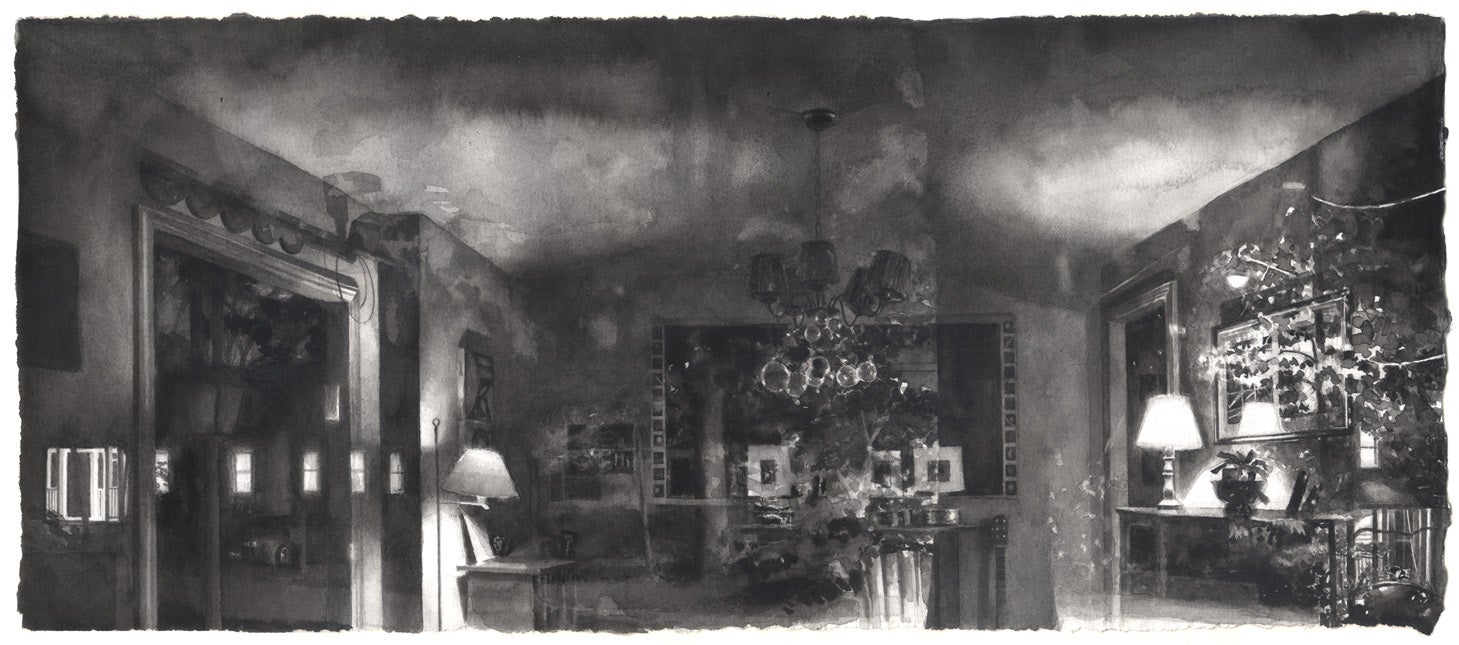
At center left of the photograph on the right is one of my Self-Portrait with Night drawings in a fairly late stage of development.  Two other works from the Self-Portrait with Night series in relatively early stages are at upper left in the left photograph.  At center of the right photograph are two landscapes called Dream Panels; the left one is entitled Summer and the right one is Spring. There is not enough detail in the shots to show the bands of writing that run through the images of both of these works but a closer view of Spring is here.  Two sketches in graphite that have been executed on watercolor blocks are on the right side of the left photo.   In the upper right of the photo on the right is a graphite drawing I began around 1985.  I am still slowly working this one.  Who knows if it will ever be finished?  It seems to me to be more about the path than the destination.

One of the great advantages of simultaneously working with so many pieces is forgetting.  Works like these are kept in piles. After disappearing into stacks of work, I often recover the drawings to see them with fresh eyes and am able to bring to them new abilities that were honed during the intervening period.  My prejudices drop away.  I begin again.

Note: The group of work shown in the photo excludes a number of works in progress: my current journal, other lesser used notebooks, all prints and related studies, and my winter drawings-in-progress.  Only my summer group is shown above.


A Fragment

June 23rd, 2008

A Fragment

I was digging through my boxes when I stumbled upon a bit of drawing; a rectangular scrap about three inches wide and one inch tall. I turned the small fragment over and rotated it in various directions. The image, although unrecognizable, was highly finished, well-worked with black watercolor and clearly a torn from another drawing. I turned it around again and suddenly recognized it as a section I tore from a small piece entitled Tomatoes; a work that left my studio several years ago.

Looking through my journals of 1989, the period when Tomatoes was completed, studies show my attention telescoping towards the kitchen window as a subject (see the sequence of pen and watercolor sketchbook pages below). Eventually peripheral elements are discarded in favor of the tomatoes resting on the sill. At the same time, details of the landscape outside the window emerge as a counterbalancing feature of interest. But the elimination process was never completely worked out in sketches. The final composition did not arrive until I tore the upper inch of the drawing off; removing a bit of window and trees from the finished work.


Above left I have replaced the fragment in the position it occupied before being torn away. Above right is the final drawing with the upper section removed. This is just one of the more dramatic ways a composition becomes resolved. This is also a reason I prefer working on a paper support to canvas or panel. Paper tears. It is versatile. It is immediate. I also like the element of risk; it is hard to return to the original composition after it is gone.


Book 62


Book 63


Book 63

Note: The subject of Tomatoes is unusual for me; the image does not depict my home. For a period I had access to a Victorian house and I tried the new setting as a challenge.

See: Tomatoes, 1989, watercolor graphite, and pen and ink on Fabriano paper, 3 x 3″, private collection.


Finding Forbears

June 15th, 2008

(above) Photograph of the artist copying in his journal at the Ashmolean Musuem, Oxford, England, June 1984.

Finding Forbears

In June of 1984 my wife, Jenny and I went to England for our honeymoon. We spent a week in London followed by a week driving around the country. We wanted to do something romantic and beautiful for the occasion, but neither of us are travelers so I look back now and imagine we were subconsciously homing in on spiritual forebears. On the trip, I certainly encountered artists who have changed the way I see the world who continue to inspire me with their achievements.

Sure, I liked John Constable’s landscapes before our trip, but when we stepped into an exhibition of his small studies at the Victoria and Albert Museum in London, I was overwhelmed. Constable communicates a thrill in depicting his world, putting painterly bravura at the service of the humble and commonplace. At Oxford’s Ashmolean Museum, I fell in love with Samuel Palmer’s work; I too wanted to invest a small page with mystery. Palmer’s varied mix of pen and ink and watercolor has informed my own drawing technique over the years. During the trip I also became aware of the work of John Martin whose command of scale is breathtaking. You may never feel as tiny as in front of one of Martin’s works. For example, his Creation of Light (see also below) convincingly evokes the immensity of the universe, juxtaposing human form with astronomical. What a master of light! The brightest point in the work is not the depicted sun, moon, or stars. It is the vaguely defined point just to the right of the sun; possibly a reflection off of a cloud bank? Who knows? Such is the imagination of John Martin.

(above) Book 130, Charles Ritchie after John Martin, Creation of Light, 2008, watercolor made from a reproduction of a mezzotint, illustration from John Milton, Paradise Lost. Published 1827.

One of the most resonant moments of the trip was our visit to Fountain’s Abbey in North Yorkshire whose ruins struck me as the greatest memento mori I had seen in my life. How do powerful cultures wither and leave these bones? I grasped the book in my pocket. Perhaps in my own way small way I seek to leave a skeleton of my life. My desire to organize my work around a linear series of journals is a satisfying conceptual framework, but it serves an emotional purpose as well. Through my own private memento mori I mark the passing, days, and months, and years; recognizing my mortality and attempting to come to terms with it.


(above) Photograph of the artist’s wife, Jenny, standing before Fountain’s Abbey, North Yorkshire, England, June 1984.


home : drawings : prints : sketchbooks : biography : conversation : statement : new work : contact

All images and text © Charles Ritchie, 2007, except where noted.